
New Zealand Certificate in Disability Support (Level 4)
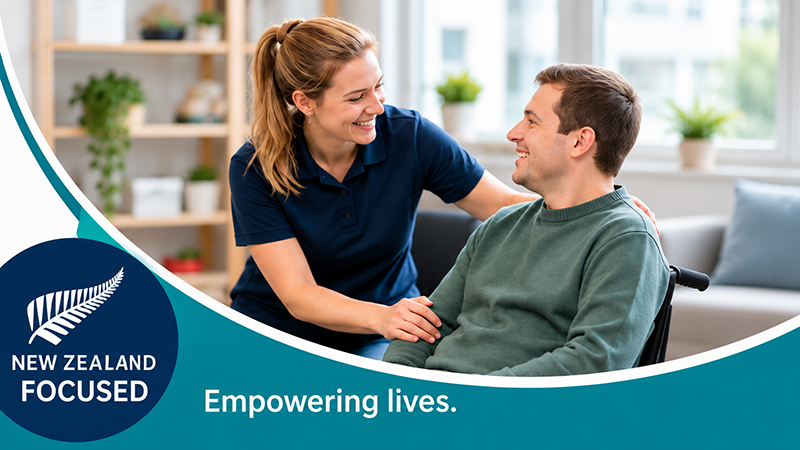
This programme aims to develop disability support practitioners who can apply professional, ethical, rights-based and person-centred approaches to support disabled people and whānau in a range of disability support settings.
The programme consists of seven modules totalling 120 credits at NZQA Level 4, taught full-time and delivered through blended delivery. The programme is designed to develop disability support practitioners who can apply professional, ethical, rights-based and person-centred approaches when supporting disabled people and whānau in a range of disability support settings.
Content includes:
- Module 1: Disability Support Practice in Aotearoa New Zealand)
- Module 2: Person-Centred Practice and Rights-based Support
- Module 3: Supporting Complex Disability Needs through Enabling Good Lives
- Module 4: Communication and Engagement in Disability Support Settings
- Module 5: Professional Development, Wellbeing and Reflective Practices
- Module 6: Cultural Responsiveness, Inclusion and Participation
- Module 7: Disability Support Workplace Practice
Work placement:
A compulsory 400-hour workplace experience is required. The NZSVET Academic Manager will assist in arranging a suitable workplace for students not already working in a disability support organisation.
The programme is delivered over 31 teaching weeks, with 3 non-teaching weeks, for a total of 34 weeks of full-time study.
Graduates will be able to apply the following skills and capabilities in disability support settings:
- Person-centred Support: Apply person-directed planning and person-centred approaches to support the individual needs, preferences, goals and aspirations of disabled people.
- Rights-based Practice: Apply human rights principles, disability rights frameworks and ethical approaches when supporting disabled people and whānau.
- Strength-based Practice: Use strength-based approaches to promote independence, choice, wellbeing and positive outcomes for disabled people.
- Supporting Complex Needs: Apply appropriate knowledge and strategies to support people with complex disability needs and promote enabling good lives.
- Effective Communication and Engagement: Communicate effectively and respectfully with disabled people, families, whānau, colleagues and other support networks.
- Cultural Responsiveness and Inclusion: Apply culturally responsive practices, including Te Tiriti o Waitangi principles, and support inclusive participation in the community.
- Professional Practice and Wellbeing: Demonstrate professional, safe and ethical practice, while using reflective practice to support ongoing professional development and personal wellbeing.
- Workplace Practice: Apply knowledge and skills effectively in a range of disability support settings, including residential services, community support, supported living, day programmes and community rehabilitation services.
Applicants must:
- Be at least 17 years old.
- NCEA Level 2 (or equivalent), or New Zealand Certificate in Health and Wellbeing (Level 3) (or equivalent).
- Evidence of relevant employment experience in health and wellbeing and/or disability support.
- Applicants aged 20+ with relevant experience may be considered case-by-case.
- Satisfactory Police Vetting / Criminal Record Check.
- Interview to assess readiness and suitability for study and workplace placement.
- International learners must meet applicable English-language, visa and insurance requirements.
This qualification may lead to further higher-level study in related disability and health and wellbeing areas such as:
- New Zealand Diploma in Health and Wellbeing (Level 5) (Practice/Applied Practice).
- New Zealand Diploma in Public Health and Health Promotion (Level 5).
- New Zealand Certificate in Kaupapa Māori Public Health (Level 5).
- Other relevant qualifications at Level 5 or above focusing on health, community, disability services, leadership or management.
Graduates may be employed in various disability support sector roles, including:
- Senior Disability Support Worker.
- Team Leader within disability services.
- Advocate for disabled people and their whānau.
- Case Manager or Coordinator in the disability support sector.
- Kaitūhono.
- Whanau Ora navigators.
Course Information
- Duration: 34 weeks full-time / 36 weeks part-time
- Credits: 120
- Level: 4
- Tuition fee: $17,000
- Material fee: $1,200
- Registration fee: $300